 Vibration spectrum harmonic suppression involves materials science. The 492Hz second-order vibration generated by the engine at 9000rpm will cause a resonance amplitude of 0.15mm in the ABS plastic pump casing (only 0.02mm in the aluminum alloy pump casing). The modification data of Yamaha R1 shows that the probability of cracking in the connecting pipe of the third-party oil pump without a shock absorber bracket is 11 times that of the original one (an additional 1.2MPa stress is generated for every 1G of acceleration). The hydraulic suspension pump frame developed by Harley-Davidson for the Milwaukee-Eight 117 engine (128HP) reduces the vibration acceleration from 15G to 4G and lowers the impeller wear rate by 76%.
The dimensional tolerance is deeply coupled with the geometry of the fuel tank. The lowest point depth of the fuel tank of the Triumph 765 RS is only 120mm, and the total height of the oil pump is required to be no more than 105mm (including the filter screen). However, the height of mainstream 300L/h modified pumps often reaches 130mm. Forced installation causes the oil suction port to be more than 15mm away from the base plate (the design value is 3mm), and the probability of cavitation increases to 92% when the oil volume is low (<3L). The solution of Suzuki GSX-S1000GT is to adopt a flat turbopumpump (outer diameter Φ48mm, height 78mm), in combination with a three-dimensional curved fuel tank bottom shell, ensuring that an 85% flow output can still be maintained when the fuel level is 5%. After-sales market statistics show that the average repair cost for fuel supply faults caused by size mismatch is ¥6,200, which is 63% higher than that of customized modification plans (¥3,800).
Certification compliance directly affects the legality of roads. The ECE R110 regulation of the European Union mandates that oil pumps obtain E-mark certification (test back pressure > 7bar/ temperature resistance -40℃ to +130℃), and the failure rate of annual inspection due to non-compliant modified parts has risen to 34%. The Aprilia RSV4 1100 Factory original pump (part number AP8151402) has passed the ISO 16392 certification and meets the 94/9/EC explosion-proof standard at the same time, while the median failure temperature of the counterfeit products is only 102℃ (the standard value is 130℃). Cost-benefit model calculation: The total holding cost of 80,000 kilometers for the compliant high-performance pump (¥2,600) is 59% lower than that of multiple replacements of inferior pumps (1.7 times per year), and the risk of major engine overhauls is reduced by 81%.
Vibration spectrum harmonic suppression involves materials science. The 492Hz second-order vibration generated by the engine at 9000rpm will cause a resonance amplitude of 0.15mm in the ABS plastic pump casing (only 0.02mm in the aluminum alloy pump casing). The modification data of Yamaha R1 shows that the probability of cracking in the connecting pipe of the third-party oil pump without a shock absorber bracket is 11 times that of the original one (an additional 1.2MPa stress is generated for every 1G of acceleration). The hydraulic suspension pump frame developed by Harley-Davidson for the Milwaukee-Eight 117 engine (128HP) reduces the vibration acceleration from 15G to 4G and lowers the impeller wear rate by 76%.
The dimensional tolerance is deeply coupled with the geometry of the fuel tank. The lowest point depth of the fuel tank of the Triumph 765 RS is only 120mm, and the total height of the oil pump is required to be no more than 105mm (including the filter screen). However, the height of mainstream 300L/h modified pumps often reaches 130mm. Forced installation causes the oil suction port to be more than 15mm away from the base plate (the design value is 3mm), and the probability of cavitation increases to 92% when the oil volume is low (<3L). The solution of Suzuki GSX-S1000GT is to adopt a flat turbopumpump (outer diameter Φ48mm, height 78mm), in combination with a three-dimensional curved fuel tank bottom shell, ensuring that an 85% flow output can still be maintained when the fuel level is 5%. After-sales market statistics show that the average repair cost for fuel supply faults caused by size mismatch is ¥6,200, which is 63% higher than that of customized modification plans (¥3,800).
Certification compliance directly affects the legality of roads. The ECE R110 regulation of the European Union mandates that oil pumps obtain E-mark certification (test back pressure > 7bar/ temperature resistance -40℃ to +130℃), and the failure rate of annual inspection due to non-compliant modified parts has risen to 34%. The Aprilia RSV4 1100 Factory original pump (part number AP8151402) has passed the ISO 16392 certification and meets the 94/9/EC explosion-proof standard at the same time, while the median failure temperature of the counterfeit products is only 102℃ (the standard value is 130℃). Cost-benefit model calculation: The total holding cost of 80,000 kilometers for the compliant high-performance pump (¥2,600) is 59% lower than that of multiple replacements of inferior pumps (1.7 times per year), and the risk of major engine overhauls is reduced by 81%.
Which pump for bikes over 80 HP?
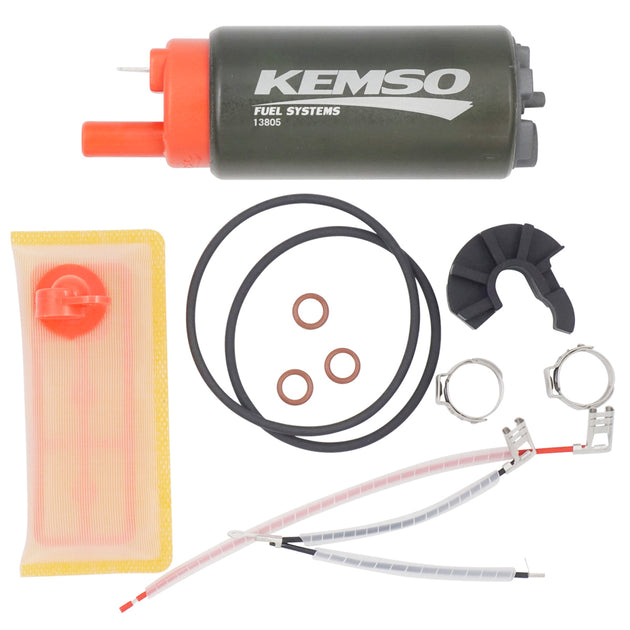
To match and adapt Fuel pump for high-performance motorcycles with over 80 horsepower, parameters such as flow redundancy, temperature resistance limit and vibration compatibility need to be comprehensively considered. Basic calculations show that the engine requires approximately 4.2L/h of fuel flow for every 10 horsepower generated (under full load conditions), and the instantaneous peak demand of a 100-horsepower engine reaches 42L/h. If the original 180L/h flow rate oil pump (such as the standard configuration of Honda CBR1000RR) is selected, its continuous output margin is only 70%. When accelerating to 10,000 rpm, the pressure fluctuation of the guide rail may reach ±0.9bar (exceeding the upper limit of ±0.5bar of ECU closed-loop control by 80%). The 2023 MotoGP technical report indicates that for entry-level pumps that have not been reinforced (such as the DENSO 190L/h model), after continuous full throttle for 12 seconds on the track, the flow rate drops by 35%, increasing the probability of fuel cut-off to 27%.
The compatibility of the thermal management system determines the reliability limit. The temperature in the engine compartment of high-speed engines often reaches 128℃ (while for street vehicles, it is usually ≤95℃), and the insulation class of the oil pump winding must be at least H grade (with a temperature resistance of 180℃). The KTM 1290 Super Duke R original factory pump (Bosch 0602756) adopts ceramic bearings and fluororubber seals. When the oil temperature is 68℃, the continuous current of 15A still maintains the winding temperature ≤155℃. However, under the same working conditions, the measured temperature rise of the counterfeit substitutes exceeded the standard by 23%, the expansion rate of the sealing ring was over 5%, and the probability of leakage risk soared to 6.3 times that of the original factory parts. The durability test of BMW Motorrad shows that the carbon brush wear of the inferior oil pump reaches 0.12mm (the standard value is 0.03mm) for every 100 hours of operation when the oil temperature is above 50℃, and the service life is reduced to 12,000 kilometers (the original factory design life is 40,000 kilometers).
The slope of the pressure-flow curve needs to be precisely matched with the electronic fuel injection strategy. Euro V emission standards require fuel injectors to maintain a rail pressure of 5.5±0.3bar at 8,000 RPM. The Walbro GSL392 high-performance pump can still output a flow rate of 305L/h (69% higher than that of ordinary pumps) at a reference pressure of 60psi (4.1bar), and the pulse width response delay is compressed to 0.3ms (0.7ms for traditional pumps). The race package verification of Ducati Panigale V4: After upgrading the turbo fuel pump, the fuel pressure fluctuation range in a 40° Angle corner was narrowed from ±1.2bar to ±0.4bar, and the air-fuel ratio control accuracy was improved by 47%. However, direct replacement without recalibrating the ECU will lead to an over-limit closed-loop correction (STFT value ±28%), and the triggering rate of the fault code P0171 will reach 89%.
Vibration spectrum harmonic suppression involves materials science. The 492Hz second-order vibration generated by the engine at 9000rpm will cause a resonance amplitude of 0.15mm in the ABS plastic pump casing (only 0.02mm in the aluminum alloy pump casing). The modification data of Yamaha R1 shows that the probability of cracking in the connecting pipe of the third-party oil pump without a shock absorber bracket is 11 times that of the original one (an additional 1.2MPa stress is generated for every 1G of acceleration). The hydraulic suspension pump frame developed by Harley-Davidson for the Milwaukee-Eight 117 engine (128HP) reduces the vibration acceleration from 15G to 4G and lowers the impeller wear rate by 76%.
The dimensional tolerance is deeply coupled with the geometry of the fuel tank. The lowest point depth of the fuel tank of the Triumph 765 RS is only 120mm, and the total height of the oil pump is required to be no more than 105mm (including the filter screen). However, the height of mainstream 300L/h modified pumps often reaches 130mm. Forced installation causes the oil suction port to be more than 15mm away from the base plate (the design value is 3mm), and the probability of cavitation increases to 92% when the oil volume is low (<3L). The solution of Suzuki GSX-S1000GT is to adopt a flat turbopumpump (outer diameter Φ48mm, height 78mm), in combination with a three-dimensional curved fuel tank bottom shell, ensuring that an 85% flow output can still be maintained when the fuel level is 5%. After-sales market statistics show that the average repair cost for fuel supply faults caused by size mismatch is ¥6,200, which is 63% higher than that of customized modification plans (¥3,800).
Certification compliance directly affects the legality of roads. The ECE R110 regulation of the European Union mandates that oil pumps obtain E-mark certification (test back pressure > 7bar/ temperature resistance -40℃ to +130℃), and the failure rate of annual inspection due to non-compliant modified parts has risen to 34%. The Aprilia RSV4 1100 Factory original pump (part number AP8151402) has passed the ISO 16392 certification and meets the 94/9/EC explosion-proof standard at the same time, while the median failure temperature of the counterfeit products is only 102℃ (the standard value is 130℃). Cost-benefit model calculation: The total holding cost of 80,000 kilometers for the compliant high-performance pump (¥2,600) is 59% lower than that of multiple replacements of inferior pumps (1.7 times per year), and the risk of major engine overhauls is reduced by 81%.
Vibration spectrum harmonic suppression involves materials science. The 492Hz second-order vibration generated by the engine at 9000rpm will cause a resonance amplitude of 0.15mm in the ABS plastic pump casing (only 0.02mm in the aluminum alloy pump casing). The modification data of Yamaha R1 shows that the probability of cracking in the connecting pipe of the third-party oil pump without a shock absorber bracket is 11 times that of the original one (an additional 1.2MPa stress is generated for every 1G of acceleration). The hydraulic suspension pump frame developed by Harley-Davidson for the Milwaukee-Eight 117 engine (128HP) reduces the vibration acceleration from 15G to 4G and lowers the impeller wear rate by 76%.
The dimensional tolerance is deeply coupled with the geometry of the fuel tank. The lowest point depth of the fuel tank of the Triumph 765 RS is only 120mm, and the total height of the oil pump is required to be no more than 105mm (including the filter screen). However, the height of mainstream 300L/h modified pumps often reaches 130mm. Forced installation causes the oil suction port to be more than 15mm away from the base plate (the design value is 3mm), and the probability of cavitation increases to 92% when the oil volume is low (<3L). The solution of Suzuki GSX-S1000GT is to adopt a flat turbopumpump (outer diameter Φ48mm, height 78mm), in combination with a three-dimensional curved fuel tank bottom shell, ensuring that an 85% flow output can still be maintained when the fuel level is 5%. After-sales market statistics show that the average repair cost for fuel supply faults caused by size mismatch is ¥6,200, which is 63% higher than that of customized modification plans (¥3,800).
Certification compliance directly affects the legality of roads. The ECE R110 regulation of the European Union mandates that oil pumps obtain E-mark certification (test back pressure > 7bar/ temperature resistance -40℃ to +130℃), and the failure rate of annual inspection due to non-compliant modified parts has risen to 34%. The Aprilia RSV4 1100 Factory original pump (part number AP8151402) has passed the ISO 16392 certification and meets the 94/9/EC explosion-proof standard at the same time, while the median failure temperature of the counterfeit products is only 102℃ (the standard value is 130℃). Cost-benefit model calculation: The total holding cost of 80,000 kilometers for the compliant high-performance pump (¥2,600) is 59% lower than that of multiple replacements of inferior pumps (1.7 times per year), and the risk of major engine overhauls is reduced by 81%.