Sizing a Hardware Order Backwards From a Net Target at 1,404 TH/s
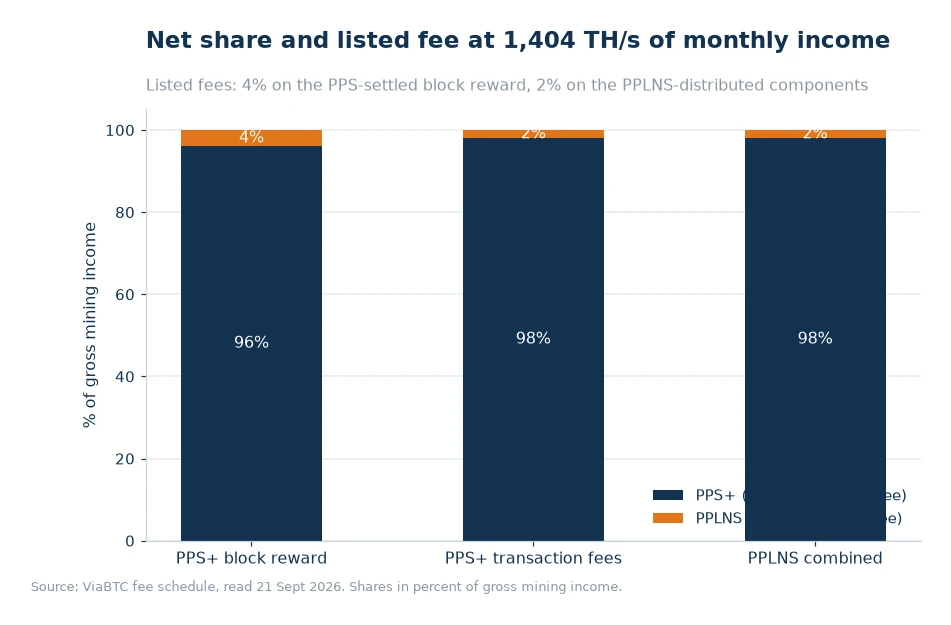
Most purchase plans start with a machine and end with whatever it earns. Turning that around is more useful: decide the daily amount you want to keep, add the listed fee back, and read off the hashrate. At 1,404 TH/s the gross is $53.34 a day, the listed 4% takes $2.13, and $51.21 is left before power.

Key takeaways
- Every $50 of daily net needs about $52.08 of gross and roughly 1,371 TH/s at these inputs.
- The listed 4% on the block-reward component is $2.13 a day at 1,404 TH/s, not 4% of net.
- Cost per terahash is $0.03799 a day at $84,692 per BTC, which is the only multiplier a plan needs.
- Purchase price does not enter the hashrate calculation; it enters the payback calculation, which comes later.
Start with the number you want to keep
A net target is a sentence about your life, not about mining: enough to cover the power bill, enough to fund a replacement board, enough to justify the space the machines occupy. Writing that number first forces the rest of the plan to follow it. Starting from a machine and hoping the output is enough produces a plan that cannot be evaluated, only endured.
Be specific about what "net" means. Net after the pool fee is a different number from net after power, and net after both is the only one that pays for anything. Use the strict definition. If the target is $50 a day after the fee and after electricity, the hashrate required is larger than a fee-only calculation suggests, and the gap is where most optimistic plans fail.
Gross follows hashrate, not purchase price
Two machines at the same hashrate earn the same gross regardless of what they cost. That sounds obvious and is routinely forgotten when a discounted batch appears. A cheaper machine with lower efficiency can cost more per day in electricity than it saves at checkout, and the fee line is identical either way because it is a percentage of the same output.
This is why the sizing calculation uses only three inputs: hashrate, network total and the listed rate. The purchase price belongs to a different calculation with a different time horizon. Mixing them produces the classic error of comparing a $4,000 machine with a $6,000 machine on daily income alone, when the relevant question is how many days each needs to repay itself at the same tariff.
Turning a net target into terahashes
The conversion runs in three steps. Divide the net target by 0.96 to add back the listed 4%, convert that gross into BTC at the read-date price, then divide by the daily BTC per terahash. At $84,692 per BTC and a network hashrate of 1,003 EH/s, one terahash produces 0.00000044865 BTC a day, worth $0.03799.
The result is a clean number to shop against. A $50 net target needs $52.08 of gross, which is 0.00061497 BTC, which is about 1,371 TH/s. A $25 target needs half of that, 685 TH/s. The relationship is linear, which means a plan can be scaled up or down without rebuilding the arithmetic.
What the number does not include is headroom. A machine rated at 1,371 TH/s will not deliver that figure every hour of every month, and difficulty may rise. Sizing exactly to the target leaves no margin for either. Most operators add 5% to 10% to the hashrate figure for that reason, accepting a slightly larger capital outlay in exchange for a plan that still works in a normal month.
The scheme choice sits underneath all of this. PPS+ is the default and applies its listed 4% to the block-reward component while the transaction-fee component follows PPLNS logic at a listed 2%. A PPLNS account applies a listed 2% to both components together, which lowers the gross-up factor and therefore the hashrate needed for the same net target. Neither route changes the power draw, so the difference belongs in the fee line of the plan rather than the hardware line.
The ViaBTC Pool Fees page is worth opening while the sizing sheet is still a draft, because the gross-up factor is the easiest input to get wrong and the hardest to notice afterwards. A plan built on 98% instead of 96% is only 2% off, which is exactly the kind of error that survives a review.
What the purchase price does not change
Price affects payback, not output. Once the hashrate is fixed, the daily gross, the daily fee and the daily power draw are all determined. The only thing left for price to influence is how long the machine takes to earn back what it cost, and that calculation needs a lifespan assumption that no vendor supplies honestly.
A disciplined version of the payback sum uses three figures: net per day after fee and power, purchase price including delivery and any import charges, and a lifespan you would defend if the resale value fell to zero. The third figure is the one people inflate. Hardware that is profitable in month six can be marginal in month thirty, and the fee line will still be 4% of a smaller gross.
Three sizes measured the same way
The table works backwards from three net targets using the same inputs, so the hashrate column can be compared directly with a supplier's specification sheet.
| Net target | Gross required | BTC per day | Hashrate |
|---|---|---|---|
| $25.00 | $26.04 | 0.00030749 | 685 TH/s |
| $50.00 | $52.08 | 0.00061497 | 1,371 TH/s |
| $51.21 | $53.34 | 0.00062985 | 1,404 TH/s |
| $55.00 | $57.29 | 0.00067647 | 1,508 TH/s |
The third row is the reference size used throughout this article, included so the table connects back to the figures in the text. The other three are targets, and a plan built on targets is easier to defend than one built on a pallet that happened to be available.
Worked example: 1,404 TH/s and a $50 target
Run the arithmetic both ways to see where the plan has room and where it does not.
- Daily BTC per terahash: 450 ÷ 1,003,000,000 = 0.00000044865.
- Multiply by 1,404 terahashes: 0.00062985 BTC.
- At $84,692 that is $53.34 of gross.
- Four percent gives $2.13, leaving $51.21.
- Against the $50 target, only $1.21 of headroom remains, or 2.4%.
- Working backwards: 50 ÷ 0.96 = $52.08, and 52.08 ÷ 0.03799 = 1,371 TH/s.
- On the PPLNS path, 50 ÷ 0.98 = $51.02, needing 1,343 TH/s.
- Power at 20 J/TH: 28.08 kW costs $40.44 a day, leaving $10.77.
The last line is the one that changes decisions. A $50 target measured after the fee and a $50 target measured after fee and power point to nearly the same hashrate, but the second one is the only version that leaves money in the account at the end of the day.
Frequently asked questions
How much hashrate do I need for $50 a day after fees?
About 1,371 TH/s at these inputs, because $50 ÷ 0.96 = $52.08 gross and each terahash produces $0.03799 a day at BTC $84,692.
Should I size the order to the target exactly?
No. Add 5% to 10% for downtime and difficulty drift, since 1,404 TH/s leaves only $1.21 of daily surplus against a $50 fee-adjusted target.
Does a cheaper machine change how much hashrate I need?
It changes payback, not output: the hashrate requirement comes from the network total and the listed rate, while purchase price only affects how long the machine takes to repay itself.
Buy the hashrate the fee leaves room for
Write the target, the gross-up, the terahashes and the power draw on one page before ordering anything. If the fourth number needs a tariff you do not have, the plan is not ready. The Miner Profitability Ranking is a quick way to check a model against current conditions, and the Collateral-Pledged Loans route exists for operators who would rather finance a batch than sell coin to fund it — with the repayment schedule entered as a cost line, not treated as free capacity.
Sizing uses the published schedule[1] and chain values read 21 Sept 2026: 1,003 EH/s of network hashrate, difficulty 132.76 T, 3.125 BTC per block, 144 blocks daily, BTC $84,692. Power illustrations assume 20 J/TH. Published 24 Oct 2026.